
SH( )P
Kastanienallee 40
10119 Berlin
PARTICIPATING ARTISTS
Alexandra Hopf
Silva Agostini
Wolf von Kries
Rolf Graf
Andrea Huyoff
Antje Engelmann
Mariechen Danz
Issa Sant
KAYA
Anna Chkolnikova
SH( )P
Kastanienallee 40
10119 Berlin
PARTICIPATING ARTISTS
Alexandra Hopf
Silva Agostini
Wolf von Kries
Rolf Graf
Andrea Huyoff
Antje Engelmann
Mariechen Danz
Issa Sant
KAYA
Anna Chkolnikova


Antje Engelmann
The Second Skin
in collaboration with Magdalena Kohler
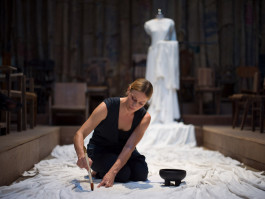
The Second Skin - Future Wishes for the Feminized Body is a large-scale textile installation consisting of a white dress that expands into a long, train-like surface made of deconstructed second-hand fast fashion. The T-shirts were purchased second-hand in Germany and originally produced in India and Bangladesh. They carry within them the traces of global supply chains, feminized labor, consumerism, and exploitation.The work conceptualizes clothing as a second skin: as a surface onto which notions of femininity, purity, availability, status, and desire are projected. The white dress references both the Western wedding gown and the draping and materiality of traditional saris. It addresses how bodies are woven into cultural imagery, social expectations, and economic systems.
As part of the opening, the lecture performance Value of the Second Skin–Repairing Relations, Imagining Futures will take place at 7 pm. Together with textile researcher Magdalena Kohler (UDK Berlin, TU Chemnitz), Antje Engelmann re-activates the work. In a dialogic exchange, artistic imagination and scientific facts regarding textile cycles, recycling, and global power structures are interwoven. The performance culminates in a collective act of "futuring," in which the audience is invited to formulate their own visions for the value of our second skin.
Opening
Saturday, May 30, 2026, 6–10 pm
Showroom #1
Lecture Performance: Value of the Second Skin - Repairing Relations, Imagining Futures, Antje Engelmann & Magdalena Kohler,
Saturday, May 30, 7 pm
Showroom #2
Performance: Activation of the Dress - Repairing Relations, Imagining Futures,
Tuesday, June 9, 2026, 1pm–6pm
Finissage
Saturday, June 13, 2026, 5–7 pm
is an artist, performer, filmmaker, and educator. In her multimedia installations, sound collages, essay films, videos, and performances, she investigates the intertwining of personal and societal narratives, incorporating ethnographic, sociological, and image-theoretical perspectives. At the center of her practice is the body as a repository of knowledge, a space of memory, and a bearer of care, labor, and transgenerational experiences. In doing so, she conceives the artistic engagement with language and vision as a form of world-making practice used to question existing structures and imagine alternative futures. Her works address motherhood, feminized labor, as well as the intersection of colonial exploitation, ecological care, the climate crisis, and societal fragility. Engelmann’s work has been exhibited internationally and has received numerous awards, including the Karl Schmidt-Rottluff Fellowship, a DAAD grant, the working grant from the Stiftung Kunstfonds, and the Berlin Senate Fellowship for Los Angeles. She is currently a visiting professor at the Berlin University of the Arts (UdK) and works in collaboration with the Soil Assembly.
operates at the intersection of design, technology, and sustainable thinking. As a research associate in the EU project STELEC and a PhD candidate, she dedicates her work to questions of circularity, recycling, and the hidden lifecycles of textile materials. As a fashion designer and researcher, she combines design intuition with technological curiosity. Between 2017 and 2023, she worked as an artistic associate at the Berlin University of the Arts (UdK), where she managed the knitting laboratory, teaching both knitting technology and an intuitive approach to materials and textile processes. Currently, she is conducting her doctoral research at the Chemnitz University of Technology, focusing on the lifecycle of wool fibers from a holistic perspective. Central to her work are post-consumer textiles: she investigates how they can be sorted, disassembled into their fiber composition, and reprocessed to open up new possibilities for handling blended fibers. Her practice is characterized by an interdisciplinary approach in which artistic thinking and technological research remain in continuous dialogue.


Antje Engelmann
The Second Skin
in collaboration with Magdalena Kohler
The Second Skin - Future Wishes for the Feminized Body is a large-scale textile installation consisting of a white dress that expands into a long, train-like surface made of deconstructed second-hand fast fashion. The T-shirts were purchased second-hand in Germany and originally produced in India and Bangladesh. They carry within them the traces of global supply chains, feminized labor, consumerism, and exploitation.The work conceptualizes clothing as a second skin: as a surface onto which notions of femininity, purity, availability, status, and desire are projected. The white dress references both the Western wedding gown and the draping and materiality of traditional saris. It addresses how bodies are woven into cultural imagery, social expectations, and economic systems.
As part of the opening, the lecture performance Value of the Second Skin–Repairing Relations, Imagining Futures will take place at 7 pm. Together with textile researcher Magdalena Kohler (UDK Berlin, TU Chemnitz), Antje Engelmann re-activates the work. In a dialogic exchange, artistic imagination and scientific facts regarding textile cycles, recycling, and global power structures are interwoven. The performance culminates in a collective act of "futuring," in which the audience is invited to formulate their own visions for the value of our second skin.
Opening
Saturday, May 30, 2026, 6–10 pm
Showroom #1
Lecture Performance: Value of the Second Skin - Repairing Relations, Imagining Futures, Antje Engelmann & Magdalena Kohler,
Saturday, May 30, 7 pm
Showroom #2
Performance: Activation of the Dress - Repairing Relations, Imagining Futures,
Tuesday, June 9, 2026, 1pm–6pm
Finissage
Saturday, June 13, 2026, 5–7 pm

is an artist, performer, filmmaker, and educator. In her multimedia installations, sound collages, essay films, videos, and performances, she investigates the intertwining of personal and societal narratives, incorporating ethnographic, sociological, and image-theoretical perspectives. At the center of her practice is the body as a repository of knowledge, a space of memory, and a bearer of care, labor, and transgenerational experiences. In doing so, she conceives the artistic engagement with language and vision as a form of world-making practice used to question existing structures and imagine alternative futures. Her works address motherhood, feminized labor, as well as the intersection of colonial exploitation, ecological care, the climate crisis, and societal fragility. Engelmann’s work has been exhibited internationally and has received numerous awards, including the Karl Schmidt-Rottluff Fellowship, a DAAD grant, the working grant from the Stiftung Kunstfonds, and the Berlin Senate Fellowship for Los Angeles. She is currently a visiting professor at the Berlin University of the Arts (UdK) and works in collaboration with the Soil Assembly.
operates at the intersection of design, technology, and sustainable thinking. As a research associate in the EU project STELEC and a PhD candidate, she dedicates her work to questions of circularity, recycling, and the hidden lifecycles of textile materials. As a fashion designer and researcher, she combines design intuition with technological curiosity. Between 2017 and 2023, she worked as an artistic associate at the Berlin University of the Arts (UdK), where she managed the knitting laboratory, teaching both knitting technology and an intuitive approach to materials and textile processes. Currently, she is conducting her doctoral research at the Chemnitz University of Technology, focusing on the lifecycle of wool fibers from a holistic perspective. Central to her work are post-consumer textiles: she investigates how they can be sorted, disassembled into their fiber composition, and reprocessed to open up new possibilities for handling blended fibers. Her practice is characterized by an interdisciplinary approach in which artistic thinking and technological research remain in continuous dialogue.

